
Why a 9.99% credit card “deal” should make you think about compounding—not shopping.
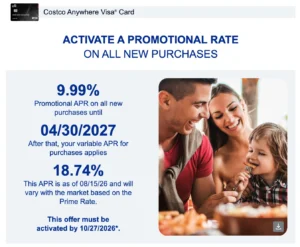
I recently received a promotional email from my credit card company offering a 9.99% promotional APR on all new purchases. The regular purchase APR on the card is currently 18.74%, so 9.99% certainly sounds like a deal. But my first thought wasn’t about what I could buy. It was the Rule of 72.
I’ve geeked out on the Rule of 72 since I learned it as a freshman in college. I may or may not have explained it on a cocktail napkin during my college dating years. Times have changed. My wife has now heard about it ad nauseam, and our homeschooled girls are plenty familiar with it, too. There’s a reason I keep coming back to it: it’s one of the simplest ways to understand the power of compound interest. 72 ÷ interest rate ≈ years to double. At 8%, money roughly doubles every nine years. At 9.99%, the doubling period is approximately 7.2 years. At 18.74%, it’s approximately 3.8 years.
Credit card balances don’t simply sit untouched for years, of course. We make payments, make additional purchases, and credit card interest calculations are more complicated than this simple illustration. The Rule of 72 isn’t a prediction of what will happen to a particular credit card balance; it’s a way to understand the power of the rate. And that power doesn’t care whether you’re an investor or a borrower. It just knows which direction the interest is flowing.
The Real Power of the Promotion
The most interesting part of the offer isn’t actually the 9.99% rate. It’s what the offer can do to the way we make decisions. Imagine considering a $5,000 purchase without financing. The question is straightforward: Is this worth $5,000 of my money? Introduce promotional financing and the question can quietly change: Can I afford the payment? Those are very different questions.
The product didn’t become less expensive. Financing simply separated the enjoyment of buying it from the pain of paying for it. When the financial sacrifice is immediate, the cost is harder to ignore. Financing pushes some of that sacrifice into the future, allowing us to enjoy the purchase today while spreading the cost across future months or years. That’s behavioral finance at work, and it can make an expensive purchase feel surprisingly affordable.
There’s another subtle shift happening, too. We begin evaluating the interest rate instead of the purchase. We compare 9.99% with 18.74% and conclude that 9.99% is a good deal. Mathematically, paying 9.99% is certainly better than paying 18.74%. But that answers a different question: Why am I borrowing the money in the first place? A discount on the cost of borrowing doesn’t necessarily make the underlying purchase a better decision.
Debt Lets Us Reach Into the Future
Think about your next paycheck. Before it ever arrives, how much of it has already been committed? Your mortgage or rent will be due. Maybe there’s a car payment, student loan, credit card balance, or buy-now-pay-later purchase waiting for its share. Those payments represent decisions made in the past using income that hadn’t yet been earned.
That’s fundamentally what debt allows us to do: reach into the future and bring purchasing power into the present. Sometimes that makes perfect sense. Most families don’t wait until they can purchase a home entirely with cash, and businesses routinely borrow capital today in an effort to create greater value tomorrow. Used thoughtfully, debt can be a useful financial tool. But when we bring future purchasing power into the present, we also give up some control over that future income.
Investing moves resources in the opposite direction. Instead of pulling tomorrow’s resources into today, we deliberately push some of today’s resources into the future. Consumer debt moves future income toward past consumption. Investing moves current income toward future freedom. That distinction matters far more than whether a promotional APR happens to be 9.99%, 5.99%, or even 0%.
The Interest Isn’t the Entire Cost
Suppose you’re considering that $5,000 purchase. If you finance it, it’s natural to think about the cost as the $5,000 purchase price plus whatever interest you’ll eventually pay. Economically, that’s incomplete. There’s another cost: opportunity cost.
Every dollar can only be used once. That same $5,000 could strengthen an emergency reserve, eliminate another debt, fund an IRA, pay for education, finance a business opportunity, take your family on a memorable trip, or simply remain available for something you can’t foresee today. None of those alternatives is automatically better than making the purchase. But choosing one necessarily means giving up the others.
That’s the reality of scarcity. Our income, assets, and time are finite, while the possible uses for them are nearly endless. Economist Thomas Sowell captured the idea succinctly: “There are no solutions. There are only trade-offs.” That’s especially useful wisdom in personal finance. A financial decision doesn’t have to be bad to carry a cost. Choosing one good thing may simply mean giving up another.
Good financial planning doesn’t make those trade-offs disappear. It helps us understand them and deliberately coordinate finite resources around what matters most. The real cost of a purchase isn’t merely what you pay for it. It’s also what you give up to have it.
Now Turn the Rule of 72 Around
Instead of asking, How cheaply can I borrow $5,000?, ask another question: What could $5,000 become if I didn’t spend it?
Suppose, strictly for illustration, that $5,000 earned an average annual return of 8% over a long period. That isn’t a guaranteed return or a prediction of future investment performance; it simply demonstrates compounding. Using the Rule of 72, $5,000 would approximately become $10,000 after nine years, $20,000 after 18 years, $40,000 after 27 years, and $80,000 after 36 years.
Same $5,000. Same basic mathematics. Completely different direction.
The conclusion isn’t that spending $5,000 today really “costs” you $80,000, or that every dollar should be invested. Taken to that extreme, we’d all be sitting in dark houses eating beans and calculating the future value of turning on a lamp. Money is meant to be used. Maybe that $5,000 creates an unforgettable family experience, solves a real problem, or buys something that meaningfully improves your life. Spending it may be exactly the right decision. The goal isn’t to avoid spending; it’s to understand what you’re trading before you make the trade.
Financial Independence Is About Choice
This is where the lesson becomes bigger than a credit card promotion. Financial independence sometimes gets reduced to extreme frugality or a race to retire as young as possible. That’s too narrow. The purpose of building wealth isn’t simply to stop working, and accumulating the largest possible pile of money isn’t much of a life objective either.
Financial independence is about choice. It’s the ability to change careers because the better opportunity pays less, start a business, help a family member, give generously, take time away from work, retire when you’re ready, or absorb an unexpected expense without having your financial life turned upside down. Money doesn’t guarantee those things, but financial resources create options.
This is also why a household can earn substantially more than it did ten years ago and still feel no closer to financial independence. Higher income creates more capacity, but it can also create access to larger mortgages, nicer vehicles, higher credit limits, and more “affordable” monthly payments. If every increase in income is accompanied by another claim on future income, the additional freedom never arrives.
Debt can reduce future choices because some portion of tomorrow’s income has already been assigned. Assets can expand them because they provide resources that haven’t already been promised elsewhere. Financial independence, then, isn’t merely a number on a retirement projection. It’s also a measure of how much control you retain over your future decisions.
Before You Accept the “Deal”
The next time a promotional financing offer arrives in your inbox, don’t begin with the interest rate. Ask yourself: Would I make this purchase if financing weren’t available? Would I still buy it if I had to pay the full price today? What will the borrowing actually cost? What happens when the promotional period ends? What else could these dollars accomplish? Does this decision increase or decrease my future financial flexibility?
That first question may be the most revealing. If the availability of financing changed your desire or ability to make the purchase, the promotion may already be doing exactly what it was designed to do.
The Rule of 72 Works Both Ways
A 9.99% promotional rate isn’t inherently good or bad. If you were already going to make a necessary purchase, understand the terms, and have a clear repayment strategy, paying a lower interest rate is obviously preferable to paying a higher one. But there’s a much bigger lesson hiding inside that promotional email.
The same mathematical force that helps investors build wealth can work against borrowers. The same dollar that purchases something today can create options tomorrow. Every financial decision represents a tradeoff between competing uses of finite resources. Compounding is indifferent. It can turn today’s savings into tomorrow’s wealth, or today’s consumption into tomorrow’s obligations.
The objective isn’t to avoid spending, eliminate every form of debt, or accumulate money simply for the sake of having more money. It’s to understand the tradeoffs and make those decisions intentionally. Financial independence isn’t about dying with the biggest account balance. It’s about having the resources and flexibility to make tomorrow’s decisions based on what matters then—not on obligations created years earlier.
The Rule of 72 works both ways. Financial independence is built when more of your future belongs to you.